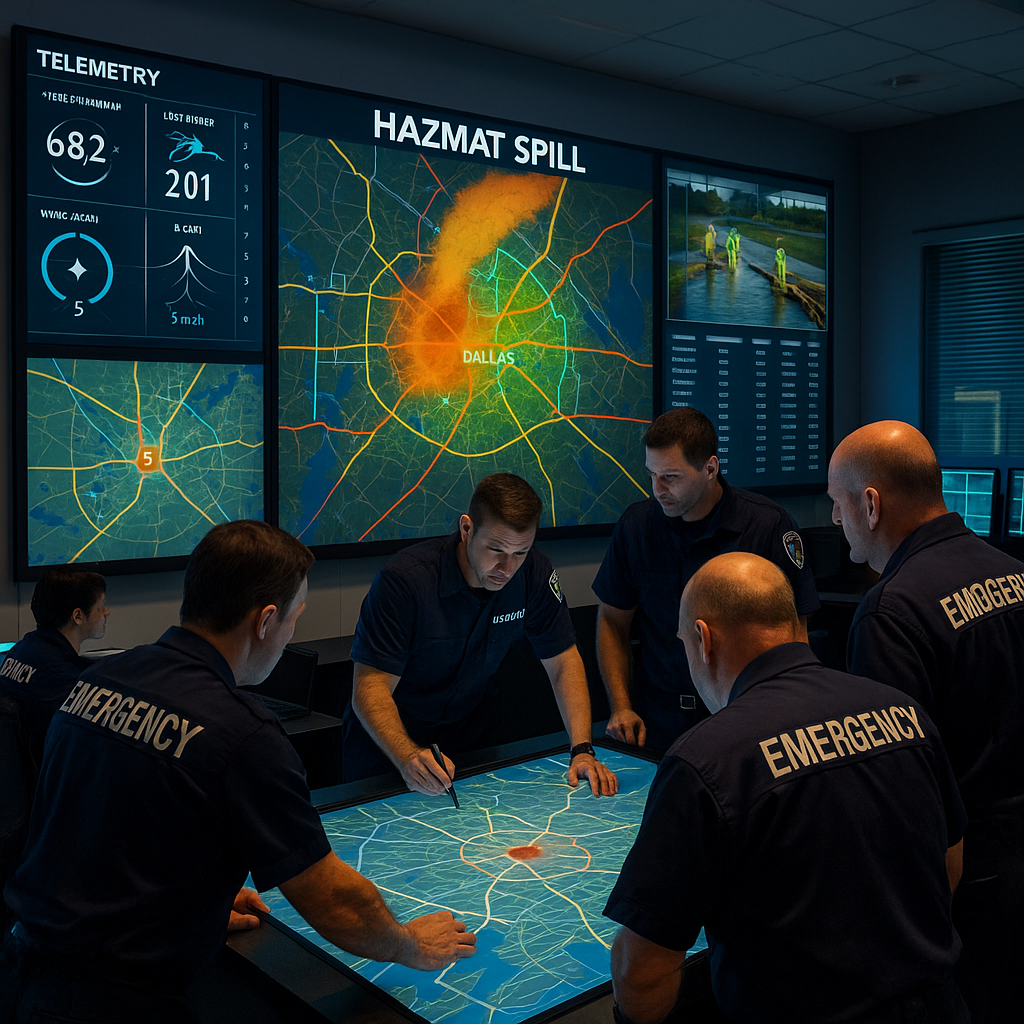
In a large city, Dallas, with a lot of highways running through, as well as refineries and industrial parks, it is surrounded by such a dense network that a single hazardous material spillage can lead to environmental disasters and public health crises. Dallas hazmat spill response requires not only a few containment booms and gloves but a complete technologically advanced command and control arrangement with a tracking incident management system that is being implemented by the modern professionals to solve problems faster than they appear. Leveraging the power of GPS telematics, GIS overlays, and cleanup coordination data, the first responders identify the location of spills, perform efficient allocations, and run the operation of quick and organized cleaning at the site. This post seeks to discuss the future of management in the Dallas–Fort Worth metropolitan area as offered by the most sophisticated tracking devices ranging from live telemetry feeds to automated alert hierarchy protocols.
Harnessing Tracking Incident Management
Tracking incident management is essentially the technology that helps convert the vast amount of location and sensor data into decisions that can be acted upon. Upon receiving a report of a hazmat spill, the dispatcher is able to access live vehicle locations, wind-direction sensors, and nearby resource availability that work together to generate solutions. Among the principal benefits are:
- Speeding Up the Situation Awareness: The live feeds directly show the exact spill footprint thereby cutting down on guesswork.
- Stats-Driven Dispatch: The decision-making for resource dispatching, be it sending booms, vacuum trucks, or special foam units, is done based on the distance and capacity.
- Responsibility and Audit: Every step is recorded starting from the alarm triggering and till the final debrief.
For instance, local transport companies such as HMDTrucking CDL jobs opportunities in Cincinnati have started interfacing their fleet’s GPS data with city municipal incident management programs to connect their tankers with the right support vehicles at the time of a spill crossing the designated thresholds automatically.
Spill Visualization Via GIS Overlays and Spill Maps
The time is so critical that one cannot afford to be verbose with the use of pictures. GIS overlays and dynamic spill map interfaces allow command centers to visualize a hazmat plume in context — over roads, waterways, and population zones. Layers may include:
- Road Network: Identifies access routes and potential bottlenecks.
- Waterways: Highlights spill risks to rivers and drainage channels.
- Population Density: Guides evacuation zones and public warnings.
- Sensitive Sites: Flags hospitals, schools, and water treatment plants.
Table 1. Common GIS Overlay Layers in Hazmat Incident Management
| Layer | Purpose | Example Use |
| Road Network | Optimize routing for response vehicles | Avoid traffic jams during peak hours |
| Waterways | Prevent chemical runoff into rivers | Deploy booms upstream of the spill |
| Population Density | Define evacuation and shelter-in-place zones | Issue timely public advisories |
| Critical Facilities | Protect sensitive sites (hospitals, schools) | Prioritize barricading or flowing |
With a clear spill map, teams can choreograph containment and cleanup like a well-rehearsed drill, even when weather or road conditions shift rapidly.

Real-Time Coordination: Live Telemetry & Resource Dispatch
Consider such a scenario: a tanker slips off the road on I-35E and starts leaking chlorine. As the first responders get ready to suite up, the sensors onboard transmit live telemetry data — such as tank pressure, leak rate, and wind speed — directly into the incident command software. Such a continuous feed grants the timely information to:
- Prioritize Hazards: If the pressure spikes, the operators are aware to withdraw.
- Precise Resource Allocation: The delivery of specific vehicles with the necessary neutralization agents occurs at no cost.
- Work Flow Auto Updates: While the booms for containment got laid in the meantime, the telemetry was confirming seal integrity.
Behind the curtains, the resource dispatching algorithm banks the assets as per their distance, availability, and what they are specialized in. The framework that is needed for shared resource is the TCEQ engine, local fire departments, and the third‑party contractors. The interoperability will be based on common telemetry frameworks and clear alert hierarchy rules that are in place.
Creating a Stronger Alert Hierarchy
A well-defined alert hierarchy is a powerful tool to make certain that the right people get the right information at the right time. A typical escalation ladder could be like:
| Alert Level | Trigger Condition | Notified Parties |
| Level 1 | Spill report received (<10 gallons) | Dispatch center, Hazmat Ops Lead |
| Level 2 | Spill exceeds safe containment line | All field teams, Safety Officer |
| Level 3 | Off‑site impact (water, population) | City officials, Public Affairs |
| Level 4 | Environmental breach or evacuation | Mayor’s office, Media relations |
Automated workflows dispatch notifications via SMS, email, and in‑app messages, guaranteeing that stakeholder notifications go out without manual intervention — or delay. Teams on the ground confirm receipt with a simple tap, feeding back status updates to headquarters.
Cleanup Coordination Data & Remediation Logs
When the immediate threat is dealt with, cleanup coordination data is crucial for the mission. The digital platforms make remediation logs — chronological records capturing:
- Arrival and departure times of each unit.
- Volume of absorbent material used.
- Soil or water samples collected.
- Waste transport manifests.
These logs not only guarantee regulatory compliance but also lay the groundwork for future response plans. By contrasting historical remediation logs, it can be seen that the average cleaning times and material efficiency help the planners to identify and stock the proper supplies.
Key Cleanup Coordination Metrics
- Response Time: From alert to arrival on scene.
- Containment Time: From arrival to successful seal.
- Material Usage: Absorbents, neutralizers, and personal protective equipment (PPE).
- Waste Volume: Tracked from spill to disposal.
By integrating cleanup coordination data into main dashboards, the incident commanders can create custom reports for agencies, clients, or insurance companies, as well as provide evidence of accountability during every step of the process.
Engaging with Drill Protocols and After‑Action Review
An enviable hazmat response is never a product of mere chance. Drill protocols that are designed to simulate extreme conditions, are run on the teams through:
- Scenario Injection: A mock spill is “reported” to the system.
- Data Feed Simulation: Telemetry, map data, and notifications are tested.
- Resource Activation: Dispatch algorithms route assets as if real.
- Performance Monitoring: Metrics like response time and communication clarity are logged.
After the drills are over, an after‑action review (AAR) is done to dissect the performance: the good, the bad, and how system integration can be improved. Most of the time such AARs have led to valuable insights, like the regional TCEQ GIS feed lagging by 30 seconds, or voluntary units need clearer notification routes.
The Integration of Systems for Fast Response
Real efficiency is achieved when various platforms, such as GIS, telemetry, and communication, along with supply‑chain management, system integration, which eliminates data silos is in place. The key integration points are:
- Unified Command Dashboard: A single pane where maps, telemetry, and logs coalesce.
- API‑Driven Data Exchange: Real‑time push of vehicle location, weather updates, and resource status.
- Mobile Field Apps: Allow responders to view spill maps, upload photos, and report local hazards.
- Automated Reporting Engines: Generate cleanup certificates, environmental compliance forms, and billing statements.
By streamlining data flows, Dallas incident management teams eliminate transcription errors, reduce response times, and free up personnel to focus on tactical decisions rather than paperwork.
Closing Remarks
As Dallas expands and industrial activities proliferate, the danger of making mistakes shrinks in the response to the hazmat spill. Tracking incident management — from GIS driven spill maps and live telemetry to setting up a structured alert hierarchy and including cleanup coordination data into a running program of decision making — is the corner that has been turned from a reactive scramble to a proactive, data‑guided operation. Recurrent drill protocols in tandem with straightforward after‑action review will assure that every stakeholder from firemen to environmental regulators are acting in unison. System integration, which brings together vehicle locators, sensor feeds, and mobile apps, puts responders in a position to seek the latest intelligence; thus, they work with confidence. Spills are not just addressed by first responders, who are subsequently acted by the TCEQ and other partners like HMD Trucking, but the city’s first responders can also be compared to fine conductors coordinating the management of incidents while protecting the ecosystem and communities along the way.